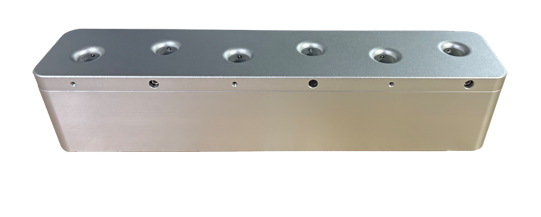
Mag-501-6 6-channel cell separation rack
Discuss your cell separation workflow, consumables and handling requirements with our team.
Product overview
A closer look at
the Mag-501-6.
The CarbonLinkAI Mag-501-6 Six-Position 5 mL Cell Separation Magnet accommodates six-position arrays of 5 mL blood collection tubes for magnetic separation of cells labeled with magnetic particles. When a sample is placed in the magnet, the magnetic particles and any cells bound to them are collected by the magnetic field, allowing the magnetic fraction to be separated from the liquid phase. Follow the selected cell separation reagent protocol for target-cell enrichment or removal of unwanted cells.
Follow the magnetic bead or cell separation reagent instructions to define labeling conditions, sample concentration, and separation time.
Specifications
Product at a glance.
- Model
- Mag-501-6
- Product type
- 6-channel cell separation rack
- Sample format
- 5 mL tubes
- Compatible labware
- six-position arrays of 5 mL blood collection tubes
- Working volume
- 0.1–5 mL
- Number of sample positions
- 6
- Bore diameter
- 13 mm
- Product family
- Cell separation ↗
Confirm consumable compatibility and configuration for your specific workflow with our team.
Product description
Mag-501-6.
Product details.
Product overview
- CarbonLinkAI 5mL Magnetic Beads Cell Separation System: Lab-Grade Performance at 1/4 the Cost of EasySep™Precision. Reliability. Revolutionary Value.Uncompromised Performance, Unbeatable ValueExperience lab-grade cell separation accuracy rivaling leading brands like EasySep™—but at one-fourth the cost. CarbonLinkAI’s 5mL magnetic rack redefines efficiency for immunology, cancer research, and cell therapy workflows, delivering elite results without the elite price tag.
Engineering Breakthroughs Behind Superior Separation
✅ 3D Dynamic Field Simulation Technology
- Simulates 10M+ magnetic field trajectories to neutralize edge decay
- Achieves ultra-uniform field stability (≤0.03T fluctuation)
- Ensures consistent bead capture across the entire plate surface
✅ Multi-Gradient Ring Magnet Array
- Patented tiered magnetic rings with precision interlacing
- Expands effective capture zone by 40% vs. conventional designs
- Eliminates “dead zones” for zero sample loss
✅ CarbonLinkAI Precision: Where Advanced Engineering Meets Accessible Science
✅ Aerospace-Grade NdFeB Magnets
- Military-spec rare-earth magnets with 10-year durability guarantee
- <0.5% magnetic decay over a decade
- Resists demagnetization under extreme lab conditions
Why Scientists Choose CarbonLinkAI
➠ 4X Cost Efficiency: Premium performance at accessible pricing
➠ Zero Compromise: 100% bead recovery with no edge effects
➠ Future-Proof Investment: Decades of stable magnetic intensity
➠ Scalable Workflows: Optimized for 5mL tubes (custom configurations available)
Stop overpaying for cell separation. CarbonLinkAI combines cutting-edge magnetic engineering with radical affordability—empowering global labs to accelerate discovery without budget constraints.
✅ CarbonLinkAI Precision: Where Advanced Engineering Meets Accessible Science
Main technical parameters:
Easily and efficiently perform magnetic cell separation procedures by using the CarbonLinkAI Magnet . The CarbonLinkAI Magnet generates a high-gradient magnetic field in the interior cavity that is strong enough to separate cells without the use of columns. This magnet is designed to hold a standard 12 x 75 mm (5 mL) polystyrene tube or 5ml flow tube.
What sample format is listed for the Mag-501-6?
What working volume is listed for the Mag-501-6?
What should I include when asking about the Mag-501-6?
Configuration & inquiry
Let’s check the fit
for your workflow.
Send your requirements with the model name Mag-501-6. We can discuss the standard product and any customization needs.
Send your requirements ↗- 01Consumables & workflow
Tube, plate or other consumable dimensions and the workflow you plan to use.
- 02Beads & process
Magnetic bead type and the separation steps in your workflow.
- 03Quantity & customization
Required quantity, equipment constraints and branding requirements.


